
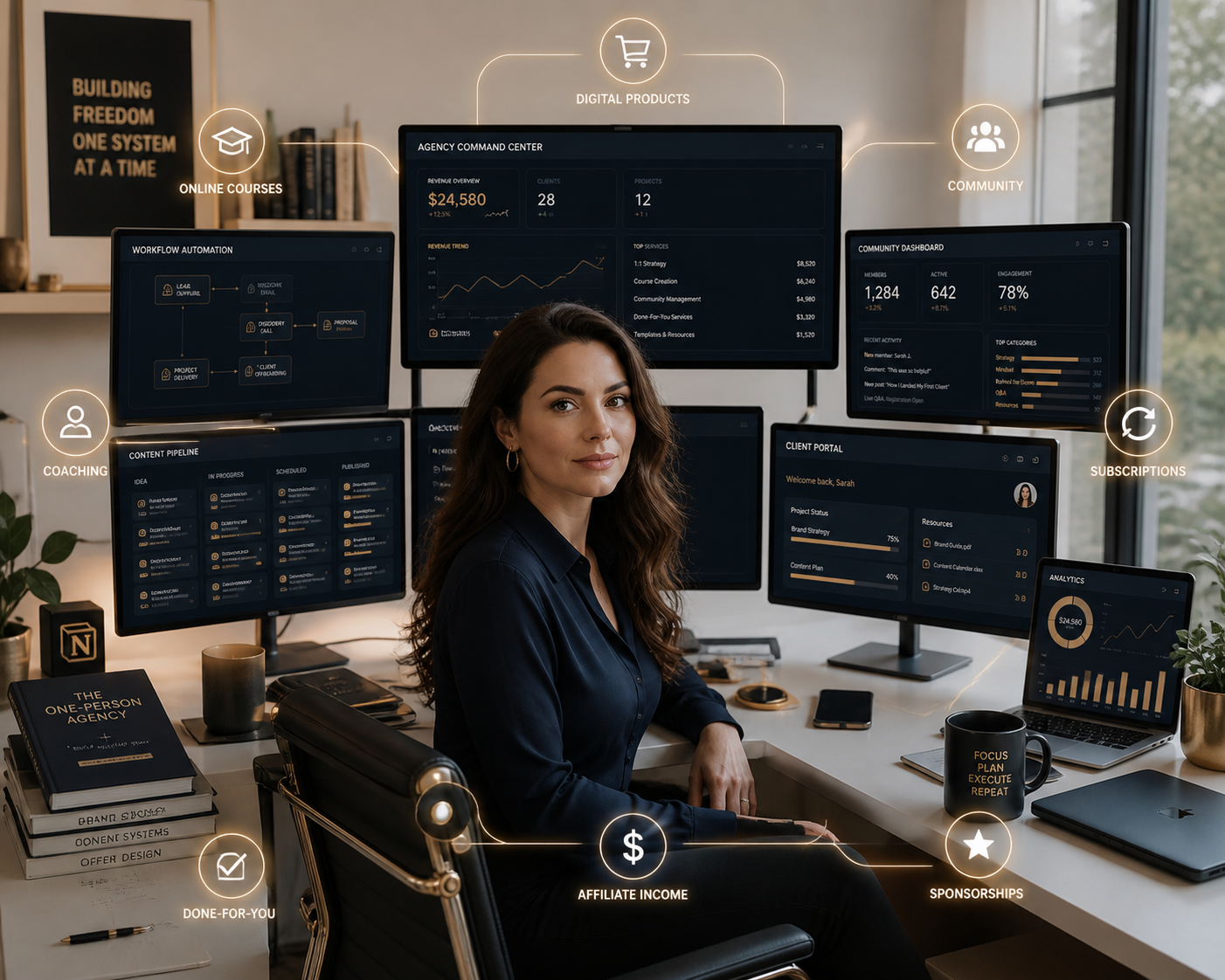
Solo operators are increasingly taking on agency-level complexity without agency-level infrastructure. Freelancers, creators, consultants, and virtual assistants are managing more clients, channels, revenue streams, and operational responsibilities than the traditional “freelancer” label suggests.
The advantage is shifting toward people who build clearer systems around the work: defined offers, repeatable delivery, thoughtful delegation, and a reliable way to keep the business moving without holding every detail in their head.
The solo-agency idea is useful because it describes something many independent workers are already experiencing.
You may still be one person. You may still call yourself a freelancer, consultant, creator, or virtual assistant. But the business around your work can become surprisingly complex.
You are not only doing the client work.
You are also finding opportunities, following up, selling, onboarding, delivering, invoicing, creating content, managing tools, maintaining relationships, and deciding what deserves attention next.
That is where the solo-agency model becomes more than a label.
It is what happens when one person starts carrying agency-level complexity without an agency-level operating structure.
The Work Gets Bigger Before the Team Does
Independent businesses often become more complex long before they become larger.
A freelancer may start with one service and a handful of clients. Then the business gradually adds more moving parts:
- multiple clients and projects
- content and audience-building
- referrals and partnerships
- email and social conversations
- digital products or recurring offers
- administrative work
- tools, automations, and documentation
None of those additions automatically justify hiring a team.
But together they create the coordination problem of a much larger business.
That is why the more useful question is not, “Am I technically an agency?”
It is:
Has my business become complex enough that improvising everything is starting to cost me?
Productized Services Make Solo Businesses Easier to Operate
One way solo operators reduce complexity is by making the work more repeatable.
Productized services are useful for exactly this reason. A clearer offer can reduce the number of decisions required in sales, pricing, scope, onboarding, and delivery.
Instead of reinventing the engagement for every new client, the operator starts building a repeatable path.
That does not mean every client receives identical work.
It means the business stops treating every project as if it were the first project it has ever delivered.
The more repeatable the commercial and delivery model becomes, the less operational weight the owner has to carry manually.
Delegation Changes the Shape of the Business
The next shift often happens when one person can no longer execute every part of the operation personally.
That does not necessarily mean building a traditional agency with departments and layers of management.
It may mean working with a virtual assistant, specialist, contractor, or collaborator who owns part of the operating load.
That is part of the broader delegation economy: small businesses adding capability without recreating a large-company structure.
Virtual assistants in particular are increasingly useful when they operate as partners in the system rather than simply waiting for individual tasks.
The better question becomes:
What part of this operation can another person reliably own?
That is very different from asking, “What can I hand off today because I am overwhelmed?”
AI Expands Capacity, but It Does Not Remove the Need for Structure
AI can make a solo operator faster.
It can draft, summarize, research, organize, analyze, and automate parts of routine work.
That extra capacity is useful, but it can also increase the amount of work one person is capable of taking on.
More output creates more things to coordinate.
More leads create more follow-up.
More clients create more delivery.
More content creates more publishing, response, and reuse.
AI can expand execution capacity, but the business still needs judgment about what matters and what should happen next.
That is one reason systems-first independent work matters more as the operator becomes more capable.
The Real Constraint Is Often Coordination
A solo business does not usually break because the owner suddenly forgets how to do the work.
It becomes harder to run because important things begin competing for the same attention.
The operator has to remember:
- which prospect needs follow-up
- which proposal is still open
- which client is waiting on something
- which task is actually important today
- which conversation happened in which channel
- which system or tool contains the relevant context
At that point, the bottleneck is not effort.
It is coordination.
And coordination is exactly where adding another disconnected app can make the problem worse instead of better.
A Solo Agency Needs Systems, Not Enterprise Software
There is an easy mistake to make once a solo business becomes more sophisticated.
The owner starts looking at the software larger companies use and assumes that growing up means copying it.
More fields.
More dashboards.
More automation.
More process.
But a one-person business does not need to imitate an enterprise.
It needs enough structure to answer a much smaller set of questions reliably:
- What matters?
- What should I do next?
- What am I waiting on?
- What is falling through the cracks?
- Is the business moving forward?
That is the practical difference between collecting business information and building an operating system for the business.
The Solo Agency Is Really an Operating Model
The most useful version of the solo-agency idea is not about status.
It is not about pretending a one-person business is larger than it is.
It is about recognizing when the work has become complex enough that the business needs systems around it.
That may mean clearer offers.
It may mean repeatable delivery.
It may mean better delegation.
It may mean fewer tools and better workflows.
It almost certainly means becoming more deliberate about how the business remembers what matters.
That is the real shift.
The business stops depending entirely on the owner keeping the whole operation in their head.