
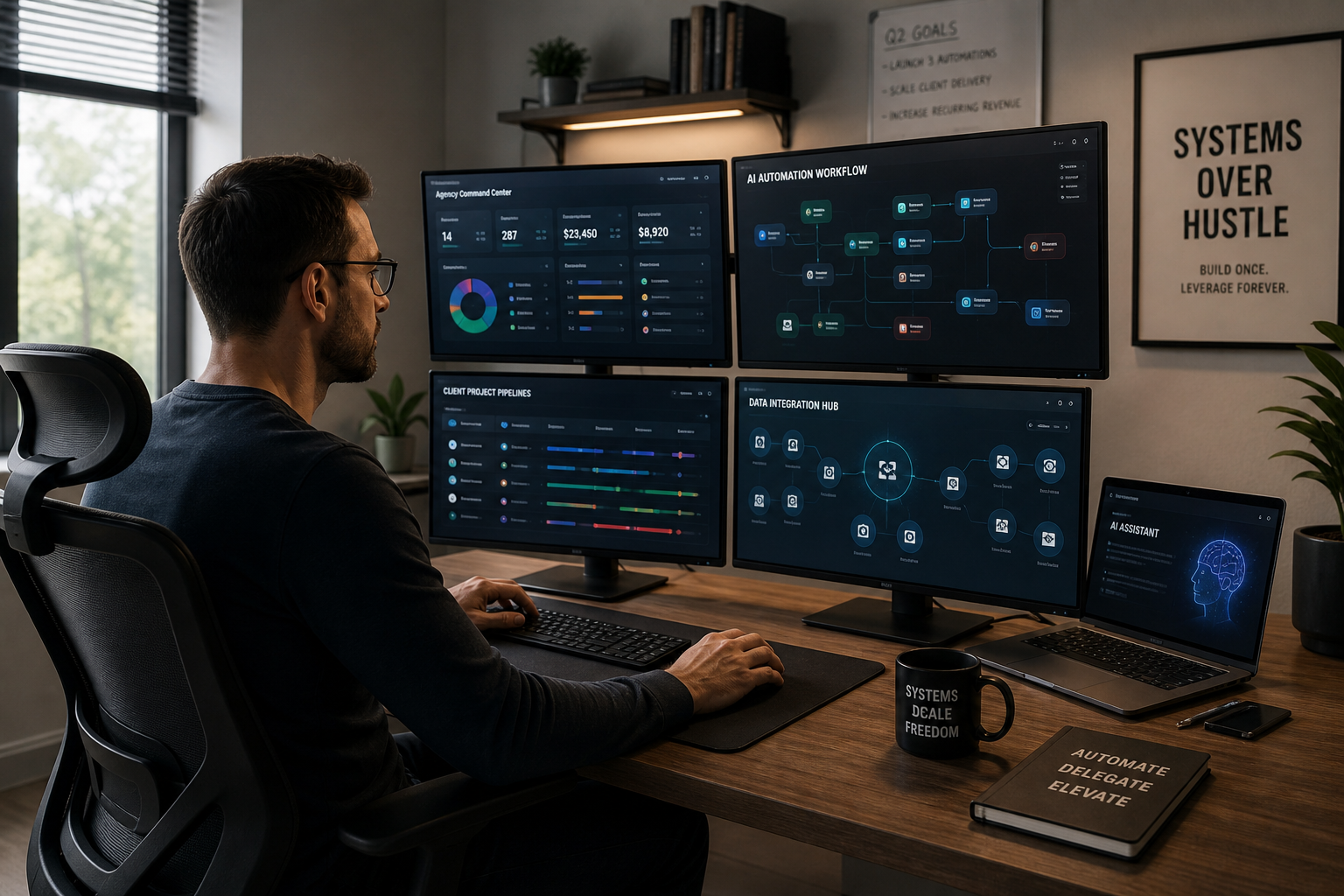
Freelancing has evolved from supplemental income to a structural part of the U.S. workforce, with 72.9 million Americans now engaged in independent work and 5.6 million earning over $100,000 annually. Clients increasingly expect repeatable workflows, automation-ready pipelines, and operational consistency rather than one-off deliverables.
AI adoption and tool proliferation have reshaped freelance expectations, with 86% of freelancers using generative AI and many managing 12–15 tools simultaneously. High-earning independents now operate more like micro-agencies, building systems to handle multiple clients and revenue streams without traditional operational support.
Freelancing in 2026 is no longer a side‑hustle economy — it’s a structural pillar of the U.S. workforce. The independent worker has evolved from gig‑based contractor to systems‑driven operator, managing multi‑client pipelines, automation‑heavy workflows, and increasingly complex digital ecosystems.
This shift isn’t theoretical. It’s backed by workforce data, economic trends, and the lived reality of freelancers who now operate more like micro‑agencies than solo workers.
Freelancing Is Now a Core Part of the U.S. Workforce
The numbers tell the story clearly:
- 72.9 million Americans now participate in independent work (Upwork, Freelance Forward 2025).
- 41% of the U.S. workforce engages in freelance activity (Upwork, 2025).
- 5.6 million independents earn $100K+ per year, a segment that grew 53% over five years (MBO Partners, State of Independence 2025).
Freelancing is no longer supplemental income — it’s a legitimate, scalable career path.
But scale requires structure.
The Systems‑First Freelancer Is Emerging
Freelancers used to be hired for deliverables. In 2026, they’re hired for systems.
Clients increasingly expect:
- repeatable workflows
- documented processes
- automation‑ready pipelines
- multi‑platform consistency
- predictable delivery cycles
This shift is driven by the same forces reshaping the creator and VA economies: AI acceleration, platform fragmentation, and rising expectations for operational clarity.
Zapier’s State of Automation 2025 found that freelancers use 12–15 tools to manage client work — a number that grows with each new platform or client requirement. Tool overload has become a structural challenge, not a productivity issue.
AI Has Changed the Nature of Freelance Work
AI didn’t replace freelancers — it changed what clients expect from them.
According to Adobe’s Future of Creativity Study 2025:
- 86% of creators and freelancers use generative AI in their workflows.
- AI adoption grew 131% year‑over‑year (URLgenius, Creator Trend Index 2025).
This means:
- deliverables are faster
- revisions are cheaper
- ideation is automated
- research is accelerated
Freelancers who rely solely on deliverables are being commoditized. Freelancers who build systems around AI are becoming indispensable.
Burnout Is Now an Economic Risk
Freelancers often avoid discussing burnout publicly, but the data is clear:
- 62% of full‑time creators (a category overlapping heavily with freelancers) report burnout symptoms (Axis Intelligence Research, Creator Economy Statistics 2026).
- 27% of freelancers say tool switching reduces billable hours (Upwork, 2025).
- 22% say subscription costs impact profitability (Upwork, 2025).
Burnout isn’t emotional — it’s operational. And operational problems require operational solutions.
Freelancers Are Quietly Becoming Micro‑Agencies
The highest‑earning freelancers increasingly resemble small agencies:
They manage:
- multiple clients
- multiple deliverables
- multiple platforms
- multiple revenue streams
- multiple workflows
But unlike agencies, they don’t have:
- project managers
- operations teams
- workflow architects
They have themselves — and whatever systems they build.
This is why freelancers are adopting:
- unified CRMs
- automation tools
- standardized SOPs
- content pipelines
- client dashboards
And why the industry is shifting toward operating systems, not more apps.
FluenceOS fits into this moment quietly — as the consolidation layer freelancers need to reduce cognitive load and stabilize multi‑client workflows.
The Future of Freelancing: Systems, Not Hustle
By 2027, analysts expect:
- freelancers to outnumber traditional small‑business employees (MBO Partners, 2025)
- AI‑assisted workflows to become standard
- multi‑client automation to replace manual admin
- unified dashboards to replace tool overload
- freelancers to operate as “solo agencies” by default
The future of freelancing isn’t about working harder. It’s about working inside systems that scale.