
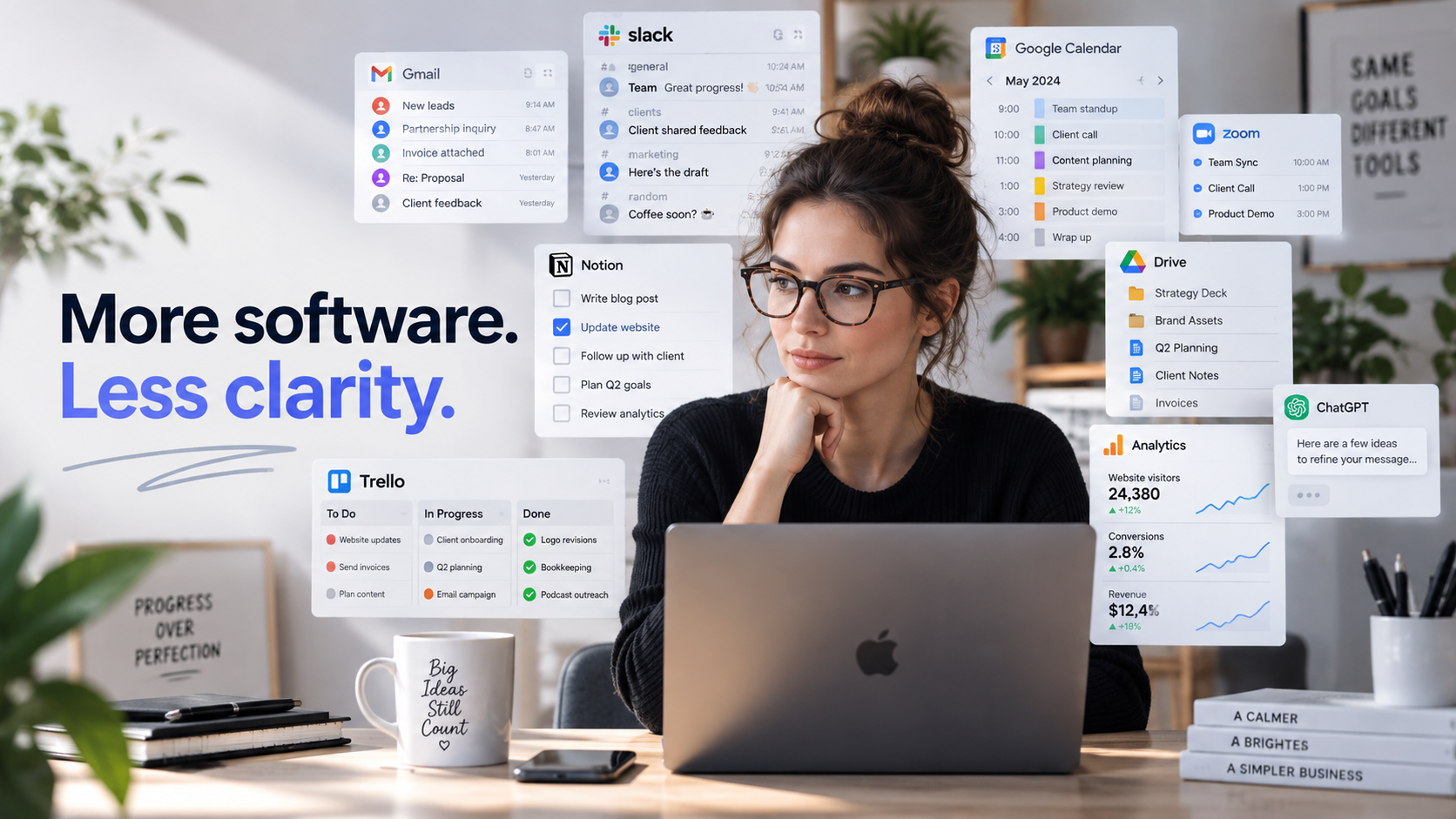
Solo businesses have more software than ever. More apps. More automations. More dashboards. More places where important things might be hiding.
And yet many people running solo businesses still wake up feeling like the business is scattered.
That feels like a contradiction.
If there are more tools than ever designed to help us stay organized, why do so many freelancers, consultants, creators, and solo operators still feel like they are piecing the business together from memory every morning?
The answer is that more software does not automatically create more clarity.
In many cases, it does the opposite.
Capability and clarity are not the same thing
Modern software is incredibly capable.
You can manage projects, capture leads, send emails, build automations, track tasks, store documents, schedule meetings, organize notes, manage content, and draft follow-ups with AI.
Individually, many of those tools are useful.
That is not the problem.
The problem appears in the space between them.
A solo business might have:
- leads in email
- conversations in DMs
- tasks in a project app
- ideas in notes
- meetings in a calendar
- proposals in documents
- follow-up reminders somewhere you hope you will remember to look
Technically, the information exists.
Operationally, the owner still has to ask:
- What matters today?
- What has gone quiet?
- What am I waiting on?
- What needs a follow-up?
- What is the next useful action?
If the person still has to answer those questions by mentally stitching five systems together, the software has increased capability without reducing coordination work.
For prospect management specifically, How to Track Freelance Prospects Without a Complicated CRM shows how to create one reliable source of opportunity state without forcing every conversation or tool into one giant platform.
The hidden cost is coordination
Software pricing pages focus on features.
But the real cost for a solo operator is often coordination.
Every additional tool creates one more place where context can live, one more place a task can hide, and one more place the owner has to check before feeling confident about what is going on.
That coordination cost is easy to miss because it does not show up as one dramatic failure. It shows up as friction:
- re-reading message threads to remember what happened
- checking multiple apps before deciding what to work on
- realizing a lead went cold because the next step never became visible
- losing time recreating context you already had somewhere else
This is one reason why so many people feel overwhelmed even while using software that is supposedly designed to make work easier. The tools are working. The system between them often is not.
We saw that more directly in The Tool Overload Epidemic: fragmentation creates mental load long before it creates a visible operational failure.
“All-in-one” can still become “all to manage”
At this point, the obvious reaction is: fine, just use one big platform instead.
Sometimes consolidation helps. Reducing needless sprawl is usually a good move.
But there is an important caveat:
Centralizing information is not the same as creating clarity.
An all-in-one tool can still leave the user with dozens of records, tabs, fields, stages, dashboards, and decisions to manage.
That may reduce the number of places the information lives while still preserving the core problem:
The owner must interpret the system, reconstruct the context, and decide what to do next.
So the question is not only, “How many tools am I using?”
The better question is:
Does the system reduce the amount of business I have to carry in my head?
Storing information is not the same as creating operational clarity
This is where a lot of business software quietly falls short.
It stores information very well.
But storing information is different from helping someone run the business.
A solo operator rarely needs another beautiful database for its own sake.
They need to know things like:
- Which opportunity needs attention right now?
- Who have I not followed up with?
- What moved forward this week?
- What is stuck?
- What is the next useful action?
That distinction is the difference between a software product that contains business data and a business operating system that creates usable direction.
It is also why having great lead sources does not automatically create a working pipeline. As we wrote in Your DMs Are a Lead Source. They’re Not Your Pipeline., the channel may create the opportunity, but a separate system is what keeps the opportunity from disappearing.
Why solo businesses feel this problem more intensely
Larger companies can hide coordination problems behind people.
One person owns sales. Someone else owns delivery. Another person manages operations. Someone else follows up. Someone else keeps the system updated.
Solo businesses do not have that buffer.
The same person is selling, delivering, invoicing, replying, planning, scheduling, and trying to think clearly enough to decide what matters next. That is exactly why one person should not be expected to operate like a sales department just because business software was designed around larger teams.
That means every point of unnecessary reconstruction lands back on the owner.
And that is why the experience of running a solo business can still feel chaotic even when the tool stack looks “sophisticated.”
The issue is not that the owner needs more discipline.
Very often, the issue is that the software stack keeps handing the burden of interpretation back to the human.
What a useful business operating system should actually do
If more software is not the answer, what is?
For a solo business, a genuinely useful operating system should do a few things well:
- bring together the small amount of context that actually matters
- surface what needs attention
- preserve the last meaningful step in a conversation or opportunity
- make the next useful action visible
- reduce reconstruction work
Notice what is missing from that list.
“Store more stuff” is not the goal.
The goal is to create enough coherence that the business owner does not need to mentally rebuild the business every day before they can move it forward.
More software is not helping if the business still depends on memory
This is ultimately the test.
You can have more apps, more features, more automations, and more AI.
But if the business still depends on memory, scattered context, and constant interpretation, then the stack may be powerful without being especially helpful.
That is also why many freelancers feel they are doing business development in bursts rather than maintaining a system. When everything is scattered, it is harder to be consistent. As we argued in You Probably Don’t Need Another List of Ways to Find Freelance Clients, the problem is often less about discovering one more tactic and more about turning useful actions into a repeatable operating rhythm.
The goal is relief, not just software
A useful system should make a solo business feel lighter to run.
Not because the work disappears.
Not because every tool becomes unnecessary.
But because the owner can open the business and understand:
- what matters
- what needs attention
- what is moving
- what to do next
That is the real promise most solo operators are looking for when they buy another tool.
Not more capability for its own sake.
Clarity.
Because more software is only helpful if it makes the business easier to run.