
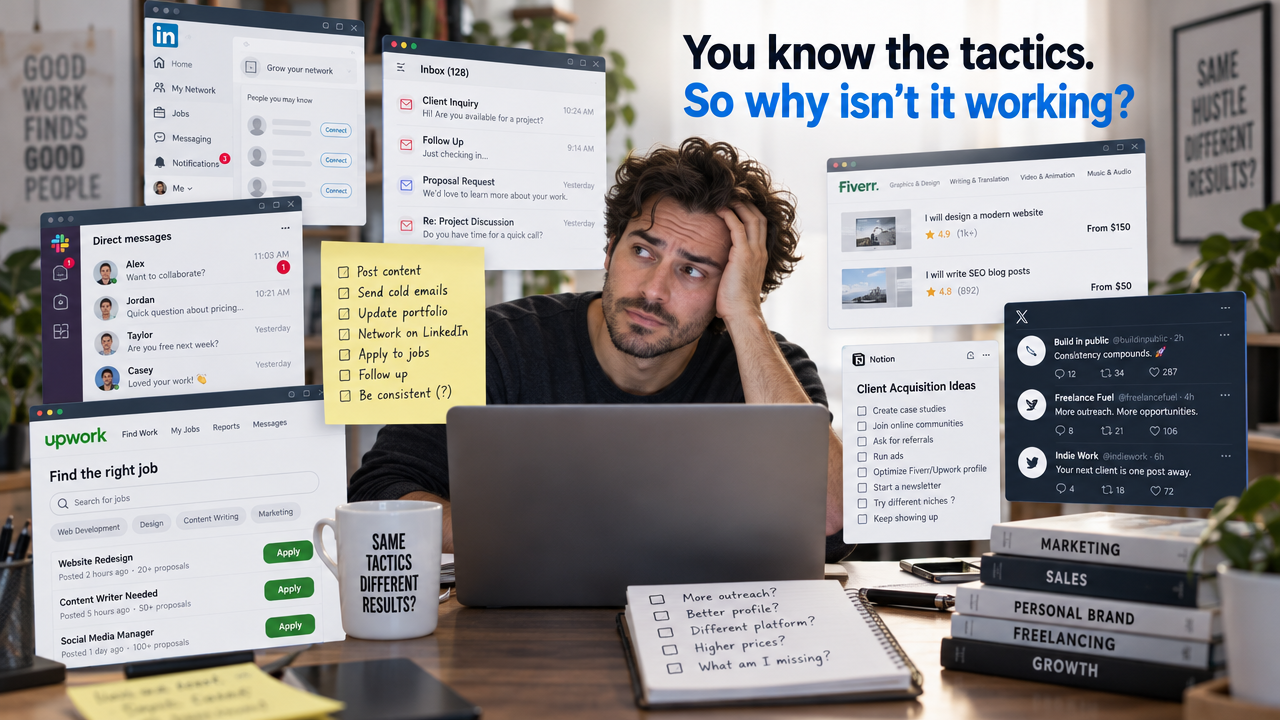
Most freelancers are not short on client-acquisition advice. They are short on consistency. The real problem is often not knowing what to do, but turning useful tactics into repeatable business-development behavior.
If you have been freelancing for more than five minutes, you have probably heard the advice.
Post on LinkedIn.
Send cold emails.
Use Upwork.
Ask for referrals.
Network more.
Join communities.
Send DMs.
Create content.
Build an email list.
Offer free value.
Comment strategically.
Pitch podcasts.
Use job boards.
Optimize your profile.
Follow up more.
Niche down.
Raise your rates.
Package your services.
Create a lead magnet.
Build a funnel.
There is no shortage of ideas.
And yet a lot of freelancers still end up asking the same question:
What actually works?
That question sounds like a tactics problem.
Often it is not.
Sometimes the real problem is that you already know plenty of things that could work.
You just do not have a reliable way to keep doing them consistently. That is why another list of ways to find freelance clients usually does not solve the underlying problem.
More Advice Does Not Automatically Create More Clients
The internet is extremely good at generating client-acquisition advice.
Every platform has its preferred answer.
LinkedIn people tell you to post.
Cold-email people tell you to build lists.
Marketplace people tell you to optimize your profile.
Creators tell you to publish content.
Referral advocates tell you to build relationships.
Most of those ideas can work.
That is exactly why the advice becomes overwhelming.
You can easily spend more time comparing tactics than actually maintaining one long enough to learn from it.
So the pattern becomes:
Try something.
Do it intensely for a week.
Get busy.
Stop.
Try something else.
Hear about another strategy.
Switch again.
Then conclude that nothing works.
The issue is not always the tactic.
The issue is that the tactic never became an operating habit.
Client Acquisition Usually Fails in the Gaps
A strategy can be perfectly reasonable and still fail because the execution is inconsistent.
You can know that follow-up matters and still get stuck on what to say or when to say it.
You can understand the value of referrals and still never ask for one.
You can know that posting consistently helps visibility and still disappear for three weeks when client delivery gets busy.
You can have warm prospects sitting in your inbox while you search for brand-new leads somewhere else.
That is where a lot of business-development effort leaks away.
Not because you chose the wrong strategy.
Because the activity happens in disconnected bursts.
If you know you are doing plenty of client-getting activity but are not sure where the process is breaking down, the free 2-minute Lead Leak Audit can help pinpoint which part of your pipeline needs attention first.
Tactic-Switching Feels Productive
This is part of what makes the problem difficult.
Changing tactics feels like action.
A new platform gives you energy.
A new outreach script feels fresh.
A new AI tool promises to save time.
A new funnel gives you something to build.
But new does not always mean better.
Sometimes it is simply easier to redesign the system than to keep using the one you already have.
That can create a strange loop:
Unclear results → change tactic → restart → no useful data → unclear results → change tactic again.
You never really learn which parts are working because nothing stays in place long enough to become measurable.
A repeatable process is less exciting.
But it is much easier to improve.
The Better Question Is Not “What Works?”
A more useful question is:
What can I do consistently enough to learn whether it works for me?
That changes the problem.
Now you are not searching for the perfect acquisition channel.
You are choosing a manageable set of actions and giving them enough continuity to produce information.
Maybe that means:
- posting useful content twice a week
- following up with warm prospects
- reaching out to a few good-fit people
- asking satisfied clients for introductions
- reviewing active opportunities every Friday
None of those actions are especially revolutionary.
That is the point.
Predictability usually comes from repeating ordinary useful actions, not discovering a secret tactic nobody else knows. That is the basic difference between reactive client hunting and building a predictable pipeline.
The System Matters More Than the Channel
There are dozens of places a client relationship can begin.
A referral.
A DM.
A website inquiry.
A LinkedIn conversation.
An email reply.
A community introduction.
A former client.
The source matters.
But what happens next matters more.
Does the conversation get captured?
Do you know what the person needs?
Do you remember when to follow up?
Can you see whether the opportunity is moving?
Do you know what the next action should be?
That is where separate tactics start becoming one business-development system.
Without that layer, every channel becomes another place where opportunities can disappear.
More Tools Can Make the Problem Worse
The same thing happens with software.
You can have:
email in Gmail
DMs in Instagram
LinkedIn conversations
notes in Notion
prospects in a spreadsheet
reminders in your calendar
AI drafts in another tab
and follow-up dates somewhere you swear you will remember.
Technically, you have all the tools you need.
Operationally, you may have no idea what deserves attention today. That is the hidden cost of tool overload and fragmented workflows.
This is why more automation is not automatically the answer either.
Automation is useful when the process is clear.
But automating a scattered process simply makes the scattering happen faster.
Before adding another tool, it helps to ask:
What decision is this supposed to make easier?
If the answer is unclear, the tool is probably adding activity rather than reducing friction.
AI Makes Execution Easier, Not Direction Obvious
AI has made it dramatically easier to generate things.
Emails.
Posts.
Follow-ups.
Lead magnets.
Sales copy.
Outreach scripts.
Research.
That is useful.
But it creates a new problem.
You can now produce more activity than ever without necessarily knowing which activity matters.
AI can draft ten follow-up emails in seconds.
It still needs context to know which prospect deserves one today.
It can generate a month’s worth of content.
It cannot automatically tell you whether content is the biggest bottleneck in your business.
It can help execute the next step.
You still need a system that knows what the next step is.
You Probably Do Not Need Another Client-Getting Tactic
This is the uncomfortable part.
The next article, podcast, thread, or YouTube video probably is not going to reveal the one missing strategy that fixes everything.
You may already know enough.
What you may need instead is a smaller operating system for the business-development side of freelancing.
A way to see:
who is active
who needs attention
what happened last
what comes next
which opportunities are going stale
whether your business-development activity is actually happening
That turns client acquisition from a collection of disconnected tactics into something you can maintain.
Consistency Is Easier When the Next Action Is Obvious
“Do more sales” is vague.
“Follow up with Jamie about the proposal” is actionable.
“Work on marketing” is vague.
“Reply to the two warm LinkedIn conversations” is actionable.
“Find more clients” is overwhelming.
“Review the three active opportunities and move one forward” is manageable.
That is what a good operating system does.
It shrinks a large, emotional problem into a clear next action.
And when those small actions happen consistently, the larger result becomes less dependent on panic, memory, or sudden bursts of motivation.
The Goal Is Not More Tactics
The goal is not to become better at collecting strategies.
The goal is to build a business-development rhythm that survives ordinary life.
Busy weeks.
Client deadlines.
Travel.
Low-energy days.
Delivery-heavy months.
Because the strongest client-acquisition strategy is not the one that sounds smartest.
It is the one you can keep doing long enough to become useful.
You already know plenty of ways to get clients.
The question now is whether you have a system that helps you keep doing the right things when the week gets busy.