
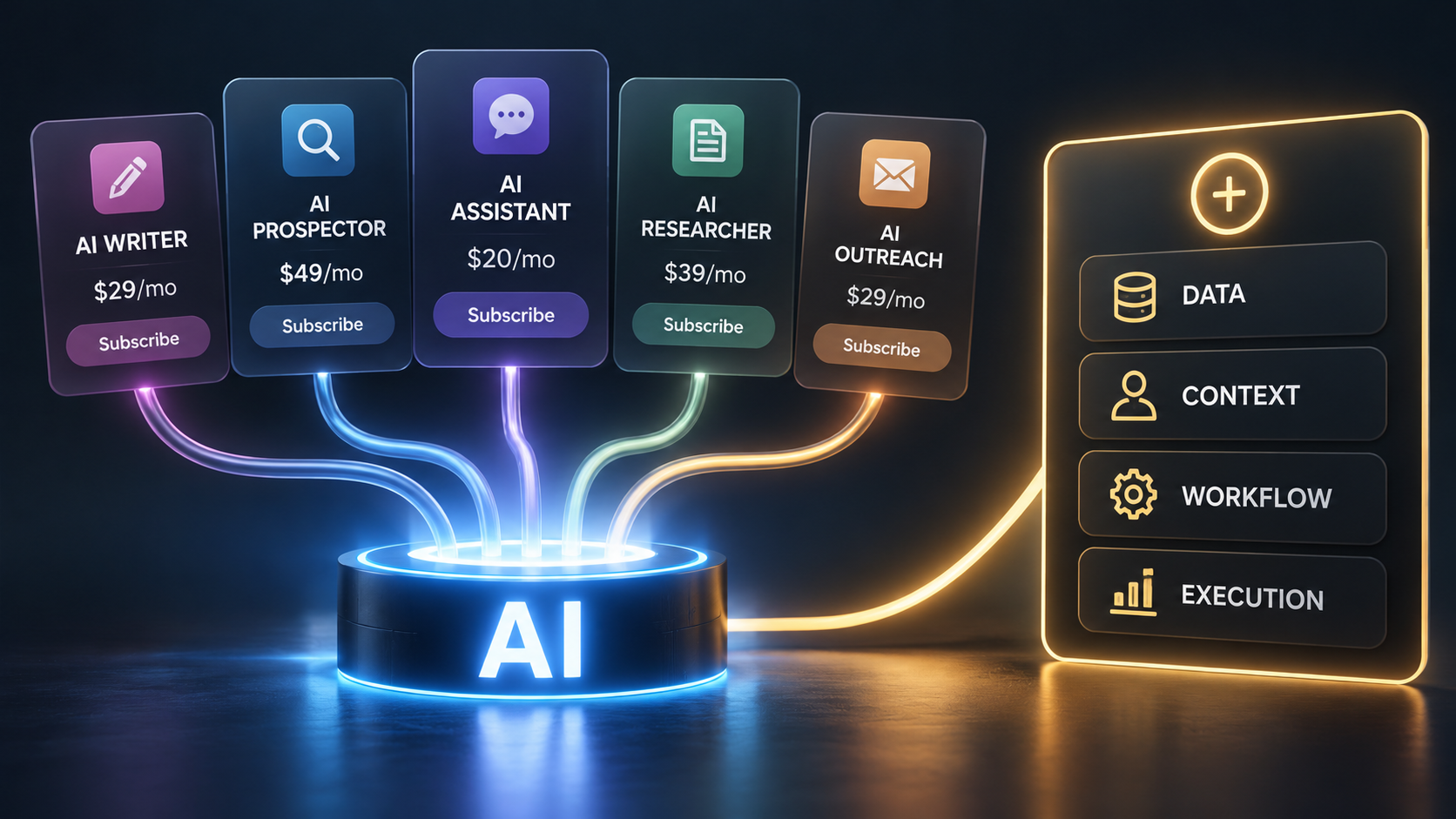
I think we need to start asking harder questions about AI software.
Not whether AI is useful.
It is.
Not whether businesses should use it.
They should, when it actually helps.
The question is simpler:
Do you really need another AI subscription to do it?
Because right now, it feels like every piece of software is racing to put AI somewhere in the product.
AI prospecting.
AI outreach.
AI content.
AI assistants.
AI workflows.
AI sales agents.
AI follow-up.
AI research.
AI everything.
And every one of those capabilities can apparently become another monthly charge.
Maybe that is worth paying.
But I would not assume it is.
AI is not some scarce technology only software companies can access
This is the part I think gets lost in the marketing.
AI is often packaged like the software company somehow owns the intelligence.
It does not.
The underlying capability is increasingly available directly to you.
That matters.
Because if a product says:
We use AI to research prospects.
My first question is:
Can I already do that with the AI I am paying for?
If it says:
Our AI helps qualify leads.
Same question.
If it says:
Our AI writes personalized outreach.
Same question.
If it says:
Our AI helps you brainstorm content.
You get the idea.
Before I add another subscription to my business, I want to know what I am actually buying.
Am I buying a capability I cannot reasonably access otherwise?
Or am I paying someone to put a workflow and a new interface around capability I already have?
Those are very different purchases.
I ran into this myself
I needed a prospecting workflow for FluenceOS.
I wanted to identify people who matched the customer profile I was looking for, evaluate whether they looked like a reasonable fit, and surface useful current contact information so I could decide who was actually worth pursuing.
There are plenty of specialized sales and prospecting products built around exactly that kind of problem.
I could have signed up for another one.
Instead, I started with what I already had.
A clear idea of who I was looking for.
A general-purpose AI subscription.
And a process.
We built a prompt that could research the market, look for people who matched the ICP, qualify them against the criteria I cared about, research current contact information, and return the results in a usable format.
That did not magically make prospecting effortless.
I still had to know who I wanted.
I still had to evaluate the output.
I still had to decide who was worth contacting.
And the quality of the underlying information still mattered.
But it solved the problem I actually had without immediately adding another platform to the business.
That experience changed the way I look at a lot of AI software.
Now my first question is:
Do I need the software, or do I need the capability?
Try the prospect-research workflow yourself
The prompt I actually used for FluenceOS was much more detailed because I wanted a repeatable research process with strict qualification and contact-verification rules.
But the core workflow is simple enough to adapt.
Replace the bracketed sections with information about your own business:
Conduct an independent prospect-discovery research assignment for my business. I provide [SERVICE YOU SELL] to [YOUR IDEAL CLIENT PROFILE]. My strongest potential clients typically have these characteristics: - [FIT CRITERION 1] - [FIT CRITERION 2] - [FIT CRITERION 3] - [OTHER IMPORTANT FIT SIGNALS] Do not assume someone is a good prospect simply because they match the industry or job title. Look for current public evidence that they have a problem, situation, project, or business need that my service could realistically help with. STAGE 1: FIND POTENTIAL PROSPECTS Research up to [NUMBER] credible potential prospects using current, publicly accessible information. Search sources such as professional websites, portfolios, public LinkedIn profiles or posts, directories, interviews, articles, public communities, and other relevant professional sources. For each candidate, establish: - Name - Business or professional specialty - Website or professional profile - Evidence they are currently active - Evidence they fit my target customer profile - Specific public evidence of a problem or need relevant to my service - Source URL - Source date where available Do not invent evidence or add weak prospects just to reach the requested number. STAGE 2: QUALIFY THEM Evaluate each candidate against my actual service and target customer. Classify each as: STRONG POTENTIAL FIT — clear evidence they match my target customer and appear to have a relevant current need. POSSIBLE FIT — some alignment exists, but important questions remain. INSUFFICIENT FIT — weak, outdated, or irrelevant evidence. Only advance Strong Potential Fit candidates to contact research. Do not lower the qualification standard just to produce a larger list. STAGE 3: VERIFY PROFESSIONAL CONTACT INFORMATION For each Strong Potential Fit candidate, look for a professional contact method they have voluntarily published for business enquiries. Prioritize: 1. Professional email on their own website 2. Professional email in their portfolio or business profile 3. Credible public business-directory contact information 4. Official business contact form Never guess or generate an email address from a person's name or domain. Never use leaked information, private databases, data brokers, or personal contact information that was not published for professional use. If you cannot verify an appropriate professional contact method, report NOT FOUND. FINAL OUTPUT Give me: 1. Research summary - Total prospects researched - Strong Potential Fits - Possible Fits - Insufficient Fits - Strong fits with verified professional contact information 2. Final shortlist Create a table containing: Name | Specialty | Website | Professional Contact | Contact Source | Evidence of Fit | Source Date | Confidence Include only candidates who pass both the fit and contact-verification standards. 3. Best prospects Identify up to [NUMBER] especially promising prospects and briefly explain: - Why they appear relevant - What problem or need you found - How my service might realistically help - What important qualification question remains unanswered 4. Research limitations Tell me where evidence was weak, outdated, inaccessible, or uncertain. Do not contact anyone. Do not draft outreach unless I ask separately. Prioritize accuracy and relevance over producing an impressive-looking number of names. Success means finding a small number of credible potential clients I can evaluate—not filling a spreadsheet with people who happen to match a job title.That is essentially the process I used.
No dedicated AI prospecting platform.
No additional token package.
No new dashboard to learn.
Just an AI tool I was already paying for, a clear definition of who I wanted to find, and enough structure to stop the model from handing me a generic list of names.
And that last part matters.
The value was not simply that AI could search.
The value came from telling it what counted as a good prospect, what did not, what evidence it needed, and where it was not allowed to guess.
A wrapper is not automatically worthless
This is where the argument can get stupid if we take it too far.
There are very good reasons to pay for specialized software.
A product can earn its place by giving you data you cannot easily get elsewhere.
It can make a complicated workflow repeatable.
It can connect multiple systems.
It can preserve business context.
It can handle permissions.
It can make something reliable at scale.
It can remove a bunch of manual work.
It can turn a ten-step process into one click.
It can give a team a shared way to work.
That is real value.
I am not arguing that every AI product is just a useless wrapper.
I am arguing that the wrapper has to earn the subscription.
That should not be controversial.
But somehow, adding the letters “AI” to a product has made a lot of us stop asking normal software-buying questions.
What exactly am I paying for?
This is the test I think solo operators should use.
When you look at another AI-powered product, ask:
What does this know that my general AI does not?
Does it have proprietary or specialized data?
Does it have access to the business state needed to make a better decision?
Does it preserve context over time?
Then ask:
What can this reliably do that would be difficult or annoying for me to do myself?
Can it execute the workflow?
Does it connect to the systems where the work already happens?
Does it eliminate repetitive steps?
Then:
What work disappears because I pay for this?
Not what new capability appears on the feature list.
What work actually goes away?
And finally:
Would I still pay for this if the AI badge disappeared from the website tomorrow?
That last question is useful.
Because AI should improve the product.
It should not be the only reason the product exists.
Another prompt box is not enough
This is probably where I am least patient.
If the primary thing an AI product gives me is another box where I type a prompt, I need a very good reason to pay for that box.
I already have a prompt box.
So do millions of other people.
A different logo above it does not automatically make it more useful.
Neither does calling it an agent.
Neither does adding a token meter.
Neither does wrapping a common task in a slick landing page and charging me by the month.
If your AI product is mostly another prompt box with billing attached, I am not sure that is innovation.
Maybe the prompt is excellent.
Maybe the interface is convenient.
Maybe it saves enough time that the subscription is still worth it.
Fine.
But now we are talking about the actual value.
Convenience.
Workflow.
Data.
Context.
Execution.
Reliability.
Those are things I can evaluate.
“Powered by AI” tells me almost nothing.
The harder problem usually comes after the AI output
This is where the conversation connects back to something I have been thinking about while building FluenceOS.
AI is getting very good at producing things.
Research.
Drafts.
Recommendations.
Summaries.
Lists.
Messages.
Ideas.
Analysis.
That can remove a tremendous amount of friction.
But producing information is not always the hard part of running a business.
Sometimes the harder problem is knowing what the information means now.
Imagine AI drafts five follow-up emails for you.
Great.
Which one actually needs to be sent today?
Imagine AI gives you fifty possible prospects.
Great.
Which ones became real opportunities?
Imagine it summarizes ten conversations.
Great.
What are you waiting on in each one?
Imagine it generates another list of things you could do.
Great.
Which thing actually matters?
That is why I keep coming back to the difference between AI capability and durable business context.
We already wrote about how AI can do more of the sales work while still needing to know what matters next.
The distinction matters more as AI gets more capable, not less.
The model can help execute.
The business still needs state.
This is also why I am deliberately cautious about AI inside FluenceOS
I could slap AI onto Pipeline OS tomorrow and start marketing it as an AI-powered sales platform.
That would probably make the feature list look more fashionable.
It would also be backwards.
You do not need FluenceOS in order to access AI.
You can already access AI.
The job of Pipeline OS is different.
It knows about the business state you are trying not to keep entirely in your head.
Who the opportunity is.
What happened.
What you are waiting on.
What the next action is.
When that action matters.
That context is what makes future AI useful.
AI might eventually help prepare a follow-up.
It might help summarize an opportunity.
It might help make the next action easier to execute.
But the AI is not the operating system.
The context is.
That distinction is also why I think more software does not automatically make a solo business easier to run.
Adding AI to every tool does not remove the coordination problem if you still have to manage all the tools.
And it is part of the broader reason I believe one person should not have to operate like a sales department just because the software was designed around one.
Capability should not automatically become another subscription
This is the bigger point.
We are entering a period where a lot of capabilities that once required specialized software are becoming much easier for an individual to access.
That does not mean specialized software disappears.
It means specialized software has to justify itself differently.
The value cannot simply be:
We have AI.
So do you.
The value has to become:
We use AI, workflow, data, context, and execution to make a specific problem materially easier for you.
That is worth paying for.
And I think solo operators should become much more demanding about the distinction.
You already have enough subscriptions.
You already have enough tools.
You already have enough things asking you to learn another interface.
Before adding another one, ask:
What can this do for me that I cannot reasonably do with the capability I already have?
Then:
What does it remove from my workload?
Then:
What context does it preserve that would otherwise be lost?
And then the question software companies probably do not want you asking:
If I canceled this tomorrow, what would I actually lose?
If the answer is a genuinely valuable workflow, proprietary data, automation, continuity, or saved effort, keep paying for it.
If the answer is:
“Well, I would lose this particular place where I type prompts…”
You may already have what you need.