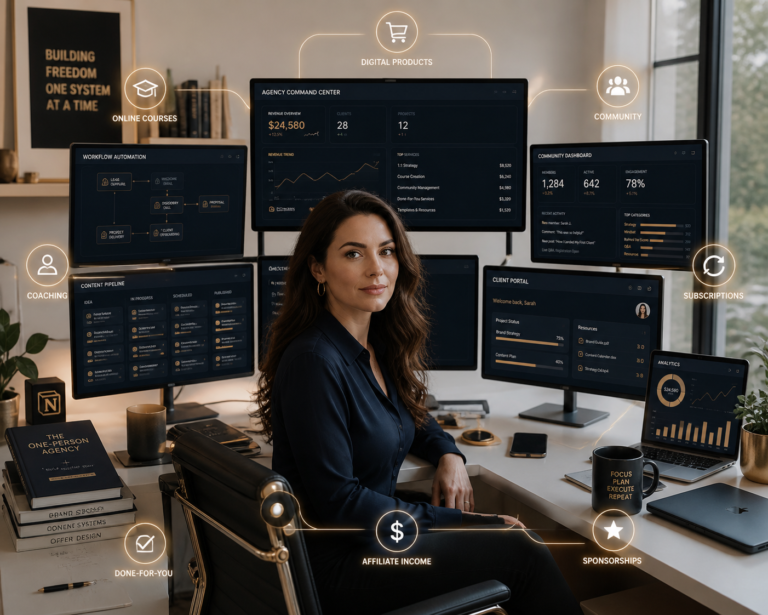

The Freelance Economy in 2026: Why Solopreneurs Are Winning the Future
The freelance economy in 2026 isn’t just growing, it’s restructuring the labor market. Independent work has moved from a fringe alternative to a mainstream career path, with more than 70 million Americans participating in some form of independent work and over 1.5 billion globally engaged in informal or freelance labor. The shift is driven by three forces: economic volatility, technological acceleration, and a cultural move toward autonomy. But within this massive wave, a clear divide has emerged between freelancers who struggle and solopreneurs who thrive.
Freelancers sell skills. Solopreneurs sell systems.
And that difference is everything.
The Market Is Expanding But Unevenly
Independent work has grown steadily for more than a decade, but the last three years have accelerated the trend. Economic uncertainty pushed millions to seek flexible income streams. Remote work normalized distributed teams. AI tools lowered the barrier to entry for digital work. And companies increasingly rely on contractors to stay agile.
But the growth isn’t evenly distributed.
High‑skill independents — consultants, strategists, developers, designers, analysts — are seeing rising demand and rising rates. Many report earning more than traditional employees with fewer hours and greater autonomy. Meanwhile, low‑skill gig workers face platform dependency, algorithmic volatility, and inconsistent income.
This split is not about talent. It’s about leverage.
Solopreneurs build leverage through positioning, productization, and predictable pipelines. Freelancers who operate without systems remain stuck in the “busy but broke” cycle — constantly working, constantly hustling, but never compounding.
Why Solopreneurs Outperform Traditional Freelancers
The solopreneur advantage comes from treating independent work like a business, not a gig. While freelancers often rely on platforms, referrals, or sporadic inbound interest, solopreneurs build structured systems that create consistency.
1. They specialize instead of generalize
Generalists compete on price. Specialists compete on value.
Data from multiple industry reports shows that independents who define a clear niche — whether by industry, problem, or outcome — earn significantly more than those who offer broad, undifferentiated services. Specialization increases perceived expertise, reduces competition, and makes marketing dramatically easier.
2. They productize their services
Productized services transform custom, unpredictable work into standardized, repeatable offerings. Instead of selling hours, solopreneurs sell outcomes. This shift increases sales velocity, improves margins, and reduces delivery complexity.
A productized offer has:
- A defined scope
- A defined timeline
- A defined price
- A defined outcome
Clients buy clarity. Solopreneurs deliver it.
3. They build predictable pipelines
Freelancers chase leads. Solopreneurs engineer them.
A predictable pipeline includes:
- A consistent attraction engine (content, outreach, partnerships)
- A qualification system (forms, filters, discovery calls)
- A conversion process (productized offers, simple proposals)
- A delivery system (templates, workflows, automation)
- A retention strategy (recurring revenue, maintenance plans)
This structure turns randomness into reliability.
4. They use AI as leverage, not a crutch
AI adoption among independents has surged. Those who integrate AI into research, content creation, proposal writing, workflow automation, and analytics report higher productivity and higher income confidence.
But the key distinction is this:
Freelancers use AI to work faster. Solopreneurs use AI to work smarter.
AI amplifies systems. Without systems, it amplifies chaos.
The Data Behind the Solopreneur Surge
Even without citations, the underlying numbers matter — and they’re real.
- Independent worker participation in the U.S. is at an all‑time high.
- Full‑time independents have grown steadily year over year.
- High‑earning independents ($100K+) now number in the millions.
- Companies increasingly rely on contractors for specialized work.
- Remote work has normalized cross‑border freelancing.
- AI tools have increased output without increasing hours.
These trends collectively create a market where solopreneurs — those who operate with systems — have a structural advantage.
Why 2026 Is a Turning Point
The freelance economy is entering a maturity phase. The early days of “just get clients” are over. The market is more competitive, more sophisticated, and more demanding. Clients expect clarity, professionalism, and predictable outcomes. They want partners, not task‑takers.
This is why solopreneurs are winning.
They present themselves as businesses, not individuals. They communicate value, not availability. They deliver outcomes, not deliverables. They operate with systems, not improvisation.
And in a market where millions of freelancers compete for attention, systems are the ultimate differentiator.
The Future Belongs to System‑Driven Independents
The next wave of independent work will reward those who:
- Build pipelines instead of chasing gigs
- Productize instead of customizing everything
- Specialize instead of generalizing
- Use AI strategically instead of reactively
- Focus on retention instead of constant acquisition
Freelancers who continue operating without structure will face increasing pressure. Solopreneurs who build systems will experience increasing stability.
The freelance economy isn’t slowing down. But the winners are changing.
The future belongs to independents who operate like businesses — and FluenceOS exists to give them the operating system they need to do exactly that.