The Creator–Freelancer Merge: Why 2026 Is the Year Solo Businesses Become Media Companies
The creator economy is no longer a separate industry — it has fused with freelancing, virtual assistance, and digital entrepreneurship. In 2026, solo operators aren’t just “service providers” or “content creators.” They are micro‑media companies, running multi‑channel brands, monetizing audiences, and delivering client work simultaneously.
This convergence is reshaping how freelancers earn, how creators operate, and how virtual assistants support them. And it’s creating a massive opportunity for FluenceOS to become the operating system powering this new hybrid business model.
The Creator Economy Has Outgrown “Influencers”
The creator economy is now a $480B global market (source: Goldman Sachs, 2025). But the biggest shift isn’t the money — it’s the identity.
Creators are no longer defined by:
- follower count
- platform popularity
- niche content
Instead, they’re defined by their business model.
2026 Creator Business Trends
- 63% of creators now offer services (editing, consulting, coaching) (source: Linktree Creator Report).
- 41% sell digital products (templates, guides, courses).
- 29% run membership communities.
- 18% operate micro‑agencies with freelancers and VAs.
Creators are becoming freelancers. Freelancers are becoming creators. And both are becoming operators.
FluenceOS Insight: This shift demands systems — not scattered tools. FluenceOS can unify content, client work, monetization, and operations into one OS.
Freelancers who once relied on referrals now rely on:
- Instagram Reels
- TikTok tutorials
- YouTube explainers
- X threads
- LinkedIn carousels
The data is clear:
- 78% of freelancers say audience building is now essential for client acquisition (source: Upwork 2025).
- Freelancers with active content channels earn 2.3× more than those without (source: MBO Partners).
- “Freelancer personal brand” searches grew 310% YoY (Google Trends, 2026).
This means freelancers are now:
- content creators
- educators
- marketers
- community builders
FluenceOS Insight: FluenceOS can serve as the backbone for freelancers who need structured content pipelines, automated publishing, and client‑delivery systems.
The VA role has evolved dramatically.
2026 VA Responsibilities
- Content scheduling
- Audience engagement
- DM automation
- Community moderation
- Research & script prep
- Editing workflows
- Publishing pipelines
- Sponsorship coordination
This is no longer “admin work.” This is media operations.
And creators are hiring VAs faster than any other role:
- Creator VA job postings grew 212% YoY (source: Fiverr Business Trends 2026).
- 47% of full‑time creators now employ at least one VA (source: Kajabi Creator Report).
- 19% employ two or more.
FluenceOS Insight: FluenceOS can become the operating system for creator‑VA teams — centralizing tasks, automations, content calendars, and deliverables.
Why This Convergence Is Happening Now
1. AI Has Lowered the Barrier to Content Creation
Creators can produce 10× more content with AI tools (source: HubSpot AI Report 2026).
2. Freelancers Need Differentiation
Content is now the #1 driver of inbound clients.
3. Creators Need Operational Support
The average creator manages 5–12 platforms simultaneously.
4. VAs Need Specialized Skill Sets
General admin work is being automated. Creator operations are not.
5. Audiences Expect Professionalism
Creators and freelancers must operate like brands — not hobbyists.
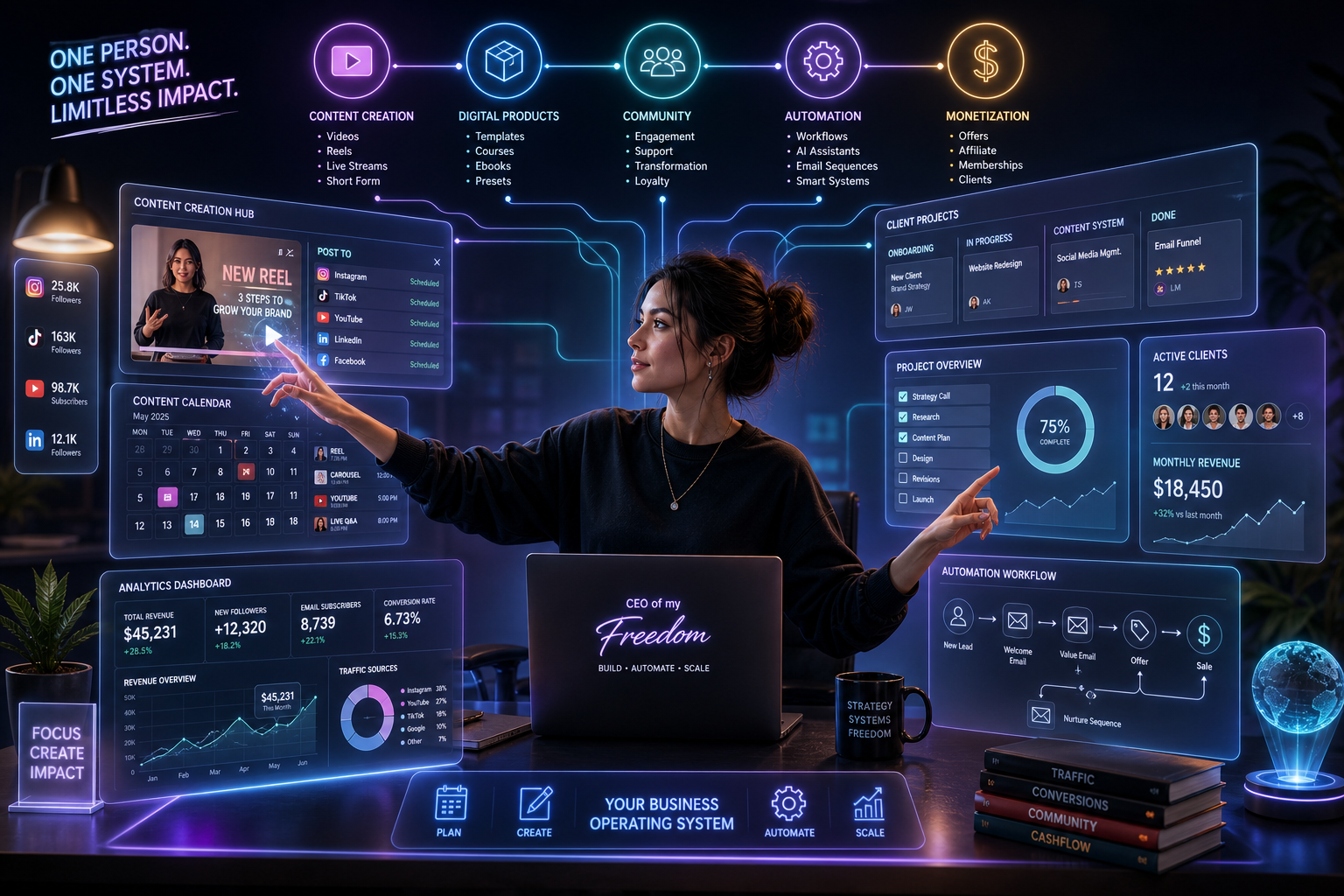
FluenceOS Insight: FluenceOS can unify all three roles into one system: Creator → Freelancer → Operator → VA → Micro‑Agency
The New Solo Business Stack (2026)
Core Components
- Content Engine — ideation, scripting, editing, publishing
- Client Engine — onboarding, delivery, communication
- Audience Engine — growth, engagement, community
- Revenue Engine — products, services, sponsorships
- Operations Engine — automation, analytics, workflows
Most creators and freelancers currently use:
- 12–22 separate tools
- 5–7 platforms
- 3–5 communication channels
- 4–6 monetization systems
This fragmentation kills productivity.
FluenceOS Insight: FluenceOS can consolidate these into one unified operating system — reducing tool overload and increasing output.
What This Means for FluenceOS Users
1. Freelancers Need Creator‑Style Systems
FluenceOS can help freelancers build content pipelines that attract clients.
2. Creators Need Operational Infrastructure
FluenceOS can manage publishing, workflows, analytics, and monetization.
3. VAs Need Specialized Creator‑Support Tools
FluenceOS can give VAs the structure to run creator operations at scale.
4. Micro‑Agencies Need Automation
FluenceOS can automate repetitive tasks and centralize team operations.